
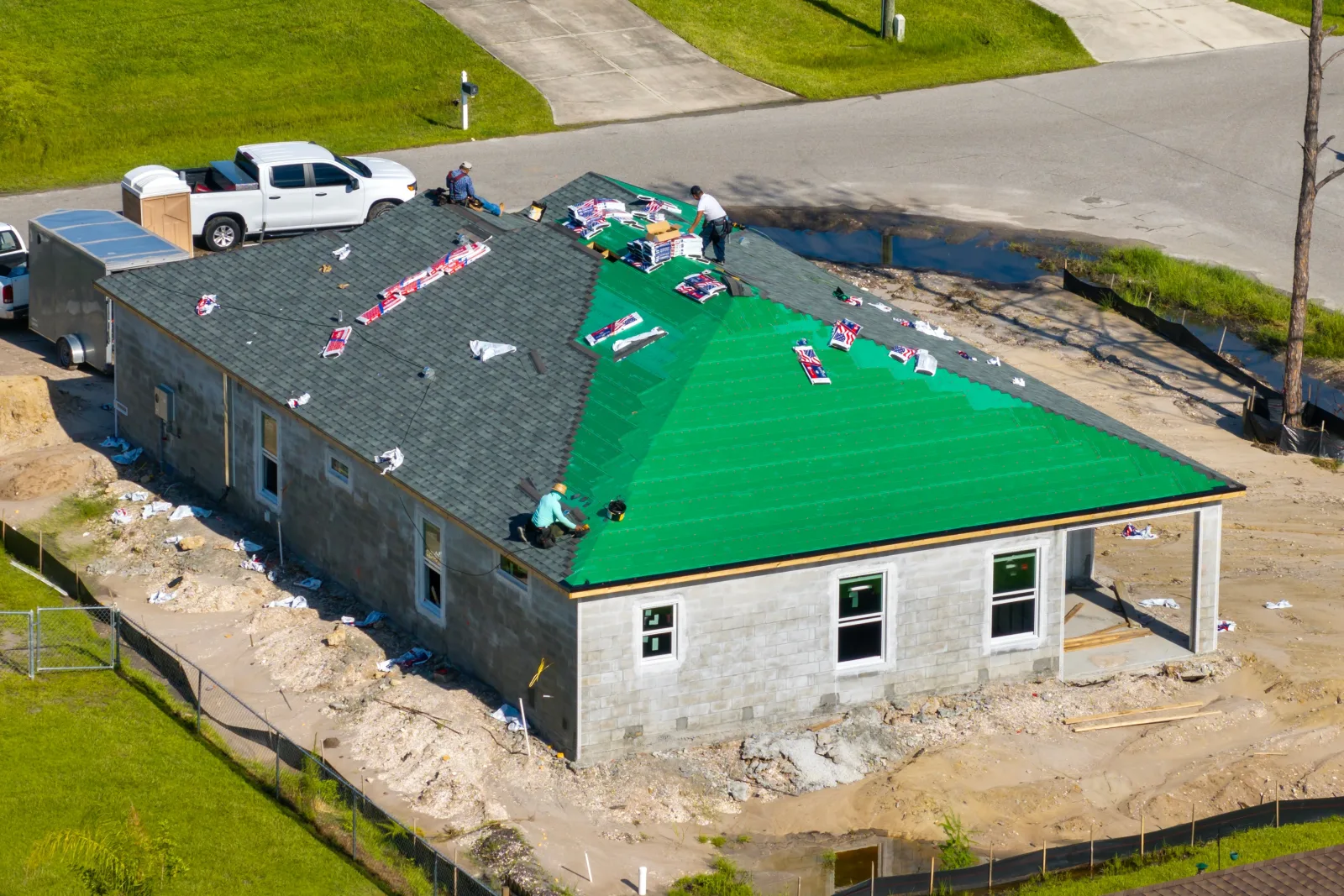

Fix and flip insurance is the phrase investors reach for when they buy a house that needs far more than paint, and it covers a much wider range of placements than most people expect. This page is about the heavy end of that range. It is written for the project where the framing gets exposed, the roof deck comes off, the electrical and plumbing leave the walls, and the building department opens a file on the job. If you are pulling permits and scheduling inspections, you are not insuring a house that happens to be empty. You are insuring a construction project that happens to sit on an existing foundation.
That difference is not cosmetic, and it is not about how much you are spending. It is about what the work touches. A standard dwelling form is written around a finished house with someone living in it. When the walls open and trades start working inside, most dwelling forms narrow or step aside through their construction and alteration language, and the exposure you are most worried about — the half-built structure itself — is the exposure the form was never drafted to carry. Investors find this out at the worst possible moment, which is after a loss, when an adjuster asks what the scope of work was on the day the fire started.
Builders risk is the line that answers that question. It is written for a structure in the middle of being built or rebuilt, and it expects an unfinished, unoccupied, actively worked-on site. The rest of the file — liability, soft costs, and the endorsed dwelling alternative for lighter work — arranges itself around that center.
The house flipper whose job starts with demolition
You are the reader this page is written for if your first week on site involves a dumpster rather than a paint sprayer. The tell is not the purchase price and it is not the ARV. It is whether the work reaches the parts of the house that hold it up, keep water out, or carry power, water and air.
In practice that means a few recognizable things. You are opening walls, and at least some of them are load-bearing, so you are adding beams, posts or headers to carry what the wall used to carry. You are taking the roof down past the shingles to the deck, replacing sheathing, and sometimes changing the roof line. You are pulling out knob-and-tube or aluminum branch wiring, replacing the panel, and running new circuits to code. You are replacing supply and drain lines rather than patching them, and you are swapping the furnace, the condenser or the water heater instead of servicing them. You may be pushing the footprint out with an addition, dormering an attic, or turning an unfinished basement into living space.
The administrative signature of a gut rehab is just as clear. Permits are pulled in your name or in the name of the entity that holds title. Inspections are scheduled in a sequence — footings, framing, rough electrical, rough plumbing, insulation, final — and the job cannot legally move forward past each one until it passes. Trades come and go on a schedule you or a general contractor controls. Materials arrive before they are needed and sit on the site. The house is empty the entire time, not because you have not found anyone to live there, but because it is not habitable and will not be until the work is signed off.
Every one of those facts matters to an underwriter, and together they describe a construction risk rather than a residential one. That is why the placement changes.
How a structural job gets read on the underwriting side
Underwriting a course of construction risk is a conversation about the job, not a form with a box to check. None of the questions below have a right answer that gets you a better deal; they have accurate answers that get you a policy that will respond.
What the scope of work actually says
The scope of work is the document the whole placement turns on. Underwriters want to know what is being removed, what is being added, whether the structure itself is being altered, and how far the work goes into the systems. A scope that says "full renovation" tells them nothing. A scope that walks through demolition, structural framing changes, roof replacement, new mechanical, electrical and plumbing, and interior finish tells them what they are insuring and when the site is most exposed. Vague scopes get conservative treatment, or they get declined.
The term and the calendar
Course of construction coverage is written for a defined stretch of time rather than an open-ended one, and underwriters ask how long you expect the job to take and what drives that estimate. Permit turnaround, inspection availability, lead times on materials and trade scheduling all show up in this answer. Extensions are a normal part of construction placements, but they are handled before the period your policy names runs out, not after. If your timeline is honest at the front end, the extension conversation later is routine.
Occupancy and what happens on the site after dark
Nobody is living in a house that is down to studs, and underwriters do not expect otherwise on this class. What they do ask about is how the site is secured — whether it is fenced, whether openings are boarded, whether there is lighting or a camera, whether someone is there daily — and whether the house sits idle between phases. An unoccupied structure that is actively worked on reads differently from one that sits untouched while you wait on a permit.
Who is swinging the hammer
Whether trades are subcontracted or self-performed changes the shape of the file. If you are hiring licensed subs for the structural, roofing, electrical, plumbing and mechanical work, underwriters will ask whether you collect certificates from them and whether written agreements are in place. If you are performing significant portions yourself, expect questions about your experience with that specific trade, because self-performed structural and mechanical work carries a different profile than self-performed finish work.
Prior losses and the vacancy question
You will be asked about prior losses across the properties you have owned and worked on, not just this one, and about anything currently open. You will also be asked how long the house has stood empty before your work begins, since a structure that sat unoccupied through a winter has different water and vandalism history than one bought at a closing table last week. Answer both plainly. A disclosed loss history is a rating conversation; an undisclosed one is a coverage conversation after a claim.
Building the stack, starting with builders risk
For a structural project, the file has a clear center and two things arranged around it.
Builders risk carries the structure and the work in it
Builders risk is the dominant line on a gut rehab, and everything else in the file is secondary to it. It is written to respond to direct physical loss to the structure while it is under construction, and — depending on how the particular policy is drafted — to the materials, fixtures and equipment intended to become part of that structure while they sit on the site waiting to be installed. That is the exposure that dwelling forms handle poorly during construction and that builders risk exists to handle well.
The limit on a builders risk placement is built around the completed value of the project rather than what you paid for the house, because the thing at risk on the day of a loss includes everything you have put into it so far. Coverage is generally arranged to run from the start of the work through completion, with the policy defining what completion means. Because this line is doing the heaviest lifting, the details worth reading are the ones about what is covered while it is stored, what happens during periods when nobody is working, and what conditions the policy imposes on the site. Builders risk is not a single standardized product across the market — the terms, the extensions and the conditions are carrier-specific, which is exactly why the scope of work conversation above matters so much.
General liability sits beside it
Builders risk answers for the building. It does not answer for people. General liability is the line that responds when a person who is not you gets hurt on the site or when you damage something belonging to someone else. On an active gut rehab, foot traffic is heavier than investors expect: inspectors, appraisers, lenders, delivery drivers, the neighbor who wanders over, and the trades themselves. A general liability policy in the name of the entity that owns the house is the standard companion to the builders risk placement, and the two are usually written separately rather than bundled.
Certificates from your subcontractors are a related but different subject. Their coverage answers for their operations; yours answers for yours. Both belong in the file.
Soft costs, when the calendar is the exposure
Soft costs is an optional layer, and it addresses a specific problem: a covered loss does not just damage the structure, it stops the clock. While the building is being repaired, the expenses that run on the calendar keep running — interest on the acquisition and rehab money, taxes, insurance itself, permit and design fees you have to incur again, and utilities. Soft costs coverage is written to respond to those continuing and additional expenses during the delay a covered loss causes. On a project financed with borrowed money and a defined holding period, this layer is worth evaluating rather than skipping by reflex.
When the job turns out to be lighter than the plan
Not every project that starts with big ambitions ends up structural. If the work stays on the surfaces — paint, flooring, cabinets, fixtures, countertops, trim — with the framing, the roof structure and the systems left alone, the placement is usually a dwelling policy carrying a cosmetic repair endorsement rather than a construction policy. That endorsement is a class rather than a specific form, and what it does varies by carrier.
The line between the two is the scope of work, not the size of the check. A large budget spent entirely on finishes does not turn a job structural, and a modest budget spent on a beam and a panel upgrade does not keep it cosmetic. If your scope moves across that line mid-project, the placement needs to move with it, and that is a conversation to have when the plan changes rather than when the inspector shows up. The finish-work side of that line has its own page, house flipping insurance for cosmetic rehab projects, where the dwelling policy leads instead of builders risk.
Permits, inspections and licensing change as you cross state lines
The rules that govern your job are written locally, and they vary in ways that affect both the work and the insurance file. Treat the following as a class of considerations to check for the jurisdiction you are working in, not as a description of any particular one.
Permitting thresholds differ. What triggers a permit, which trades require separate permits, whether a homeowner or owner of record can pull certain permits at all, and how long a permit stays valid before it expires or needs renewal are all set at the state or municipal level. Inspection regimes differ too, in which stages require sign-off, who performs the inspection, and how much of the work must remain open and visible when the inspector arrives.
Contractor licensing is its own layer. States differ on which trades require a license, at what thresholds, whether an owner performing work on a house they hold can do so without one, and what the consequences are for work performed by an unlicensed party. That last point reaches the insurance file directly, because unpermitted or improperly licensed work can complicate a claim, and because underwriters ask about it.
States also differ on disclosure at resale and on lead, asbestos and other hazardous material handling in older housing stock. Confirm the rules locally for the jurisdiction your house sits in before you rely on any general statement, including this one.
The losses that actually show up on a gut rehab site
Claims on structural projects cluster in a handful of recognizable patterns. Knowing them is useful because most of them are partly preventable and all of them are worth understanding before you choose terms.
Theft of materials is the one investors encounter most often, and it is not usually the finished cabinets. It is copper, wire, lumber, the new furnace or condenser sitting in the basement waiting for the mechanical rough-in, appliances delivered ahead of schedule, and tools left by trades. An open, unoccupied structure with visible material and a predictable empty stretch after the crew leaves is an attractive target, which is why underwriters ask about fencing, lighting and how deliveries are timed against installation.
Fire during the trades' work is the loss with the largest consequence. Roofing torches, soldering, heat guns, temporary wiring, space heaters running in an unheated house and combustible debris piled in a corner all show up in the causes. A structure that is open at the framing stage has no compartmentation and very little in the way of the finishes that slow a fire down, so a small ignition becomes a total loss faster on a gut rehab than it would in a finished house.
Water through an open envelope is the quiet one. The roof deck is exposed between tear-off and dry-in, windows are out, siding is off, and a storm arrives overnight. Water gets into new framing, insulation and subfloor, and the damage is often discovered days later as staining or as material that has already begun to fail. The related version is a supply line pressurized before the system is finished, or a house left without heat as temperatures drop.
Injury to visitors rounds out the list. Open stairwells, floor penetrations, trenches, extension cords, scaffolding and loose material create a site where anyone who walks through without a hard hat and attention is exposed. Some of those people have a legitimate reason to be there and some do not, and both categories generate claims.
Closing with hard money, and the insurance step that happens first
If you are borrowing to buy and rehab, the lender has requirements about insurance and they are not negotiable at the closing table. Hard money lenders and private lenders write these into their loan documents, and their servicing departments verify them before funding.
The core requirement is that evidence of the right coverage exists at closing, not afterward. On a structural project that means a builders risk policy bound and effective on or before the funding date, with the limit tied to the completed value the lender is underwriting to rather than the purchase price alone. Lenders reviewing a rehab loan generally know the difference between a construction placement and a dwelling policy, and a dwelling form submitted on a permitted structural job is a common reason a closing slips.
The second requirement is that the lender is named on the policy. Depending on the loan and the lender’s own practice, that appears as a mortgagee, a loss payee, or both, and the exact name and address they give you must be reproduced exactly as written. Their interest is in being paid from a loss, so the naming language is not a formality to them. If your loan is sold or serviced by another party mid-project, the naming needs to be updated, and that update is on you to request.
Lenders may also ask for the general liability policy, for certificates from the trades performing the work, and for the policy to run at least through the maturity date of the loan. Because rehab money is often advanced against a draw schedule tied to inspections, the lender is tracking the job’s progress anyway. Keeping the insurance file current with the project as it moves is far easier than reconstructing it when a draw request stalls.
Getting a quote started on a structural job
The submission for a course of construction placement is more detailed than a dwelling quote, and the fastest path is having the information ready before you start rather than assembling it over a week of emails.
Have the address and the details of the existing structure: the year it was built, the square footage, the construction type, the roof, and the current condition, including anything already damaged or missing. Have the acquisition details and the date you closed or expect to close.
Have the scope of work in writing, broken out by trade, and be specific about the structural, roofing, electrical, plumbing and mechanical portions. If an architect or engineer drew anything, note it. Have the completed value you and your lender are working toward, and the budget for the work itself, since the limit is built around what the finished structure represents rather than what you paid.
Have the schedule: your intended start date, your expected completion, and the permits already issued or applied for. Have the delivery method — which trades are subcontracted, which you are self-performing, who the general contractor is if there is one, and whether you collect certificates.
Have the ownership and lender details: the exact legal name of the entity taking title, and the naming instructions from your lender if financing is in place. Finally, have your loss history across the projects you have owned, whether or not they were insured with the same carrier.
If you have a quote in hand already and want to know what you are reading, how to read an insurance quote on a rehab walks the document line by line.
Bring that set and the placement conversation is short. Bring half of it and the questions above turn into a week of back-and-forth while your permits sit.
Fix and flip insurance by state
A structural job answers to whoever licenses the trades, issues the permit and inspects the work, and none of that is federal. Each state page below is written from that state’s own agencies and forms.
- Alabama
- Arizona
- Arkansas
- California
- Colorado
- Connecticut
- Delaware
- Florida
- Georgia
- Idaho
- Illinois
- Indiana
- Iowa
- Kansas
- Kentucky
- Louisiana
- Maine
- Maryland
- Massachusetts
- Michigan
- Minnesota
- Mississippi
- Missouri
- Montana
- Nebraska
- Nevada
- New Hampshire
- New Jersey
- New Mexico
- New York
- North Carolina
- North Dakota
- Ohio
- Oklahoma
- Oregon
- Pennsylvania
- Rhode Island
- South Carolina
- South Dakota
- Tennessee
- Texas
- Utah
- Vermont
- Virginia
- Washington
- West Virginia
- Wisconsin
- Wyoming
More on structural jobs
- Builders Risk vs. a Dwelling Policy With a Cosmetic Endorsement
- Assigning a Contract Versus Rehabbing It
- How Much Does Fix and Flip Insurance Cost? What Moves It
Learn more
- Builders risk insurance
- Dwelling policy with a cosmetic repair endorsement
- General liability insurance
- All coverages
- States we serve
- Get a quote on a project
Insurance is regulated state by state. Your own state department of insurance is the authority on licensing and on how to file a complaint — for example the Indiana Department of Insurance or the Texas Department of Insurance.
Questions house flippers ask about a structural job
Is builders risk written around the owner of the house or around the people doing the work?
It is written around the party with an insurable interest in the structure, which on a rehab you have financed and hold title to is you or your entity. The trades working on the job carry their own policies for their operations. The named insured on your builders risk should match the entity on the deed, and your lender is added by name for its interest.
The permit is in one name and the deed is in another. Does that matter to the placement?
It matters enough to sort out before binding. Underwriters look for the named insured, the owner of record and the permit holder to line up, because a mismatch raises questions about who is responsible for the work and who has an interest in the structure. If the permit had to be pulled in a personal or contractor name for a local reason, say so up front so the file reflects the actual arrangement.
What are soft costs, and when do they belong on a structural placement?
Soft costs coverage responds to expenses that keep accruing while a covered loss delays the job — loan interest, taxes, insurance, utilities, and design or permit fees you have to incur a second time. It belongs on a project where a stoppage would be expensive on the calendar, which describes almost any rehab funded with borrowed money against a defined holding period. It is an optional layer rather than part of the base placement.
The building department halted my job. What does the carrier need to hear?
Tell your agent as soon as it happens. A stop-work order usually means the site sits idle, and an idle structure is a different exposure than an active one, particularly if the work is stopped with the envelope open. The carrier may want to know how the site is being secured and how long the delay is expected to run, and if the pause pushes you past the period your policy names, the extension is handled while coverage is still in force.
If a covered loss destroys work that was already finished, does the policy pay to build it again?
That is the reason the limit on a construction placement is built around the completed value rather than the purchase price. The structure grows in value as the work goes in, and the policy is meant to reflect what stands on the site at the time of loss. If your scope expands significantly after binding, tell your agent, because a limit set to an earlier version of the project may no longer match what you would have to rebuild.
The roof deck will be open to weather between phases. Is that a coverage problem?
It is a risk-management question that becomes a coverage question if it is handled carelessly. Policies carry conditions about protecting the structure from further loss and about the site being reasonably maintained, and an envelope left open without temporary dry-in when weather is forecast works against you at claim time. Plan tear-off and dry-in as one sequence, and tell your agent if the roof will stay open for an extended stretch.
My lender asked for a draw schedule. Does the insurance side ever see it?
The draw schedule is primarily a lending document, but it is useful on the insurance side because it maps the project’s phases against the calendar. Underwriters reviewing a structural submission are trying to understand the same sequence — when the structure is most exposed, when materials arrive, and when the job is expected to close out. Sharing it with your agent usually shortens the scope of work conversation rather than lengthening it.
Tell us what the scope of work is
Send us the address and the scope of work.