
Assigning a Contract Versus Rehabbing It
This is general education rather than legal, tax or lending advice; confirm anything specific with your own attorney, CPA or licensed adviser.
A property contract answers to a party, not to a building. Before anything can be bound, whoever is named has to stand to lose something if the structure is damaged — and that requirement is what separates the route ending in ownership from the route that never takes title at all.
Everything below is that one question, asked again at each point where the answer changes.
The condition that asks who would actually lose something
The published residential special form, carried in full by Maine’s Bureau of Insurance under designation HO 00 03 05 11, prints a condition headed Insurable Interest And Limit Of Liability. Its opening words are the ones worth sitting with. It begins by supposing that more than one person may hold an insurable interest in the covered structure, and then limits what it will pay any of them to the size of that particular interest.
Two things are packed into one sentence. Interest is plural by default — the document does not imagine a single owner standing alone. And interest is a quantity, so a name on a contract is worth whatever that name would actually be out and no more. How that quantity is measured on the day damage occurs is the subject of what happens to cover once a finished house is under contract; what matters here is the earlier half, which is whether a given party has any of it.
That is the whole test this page runs. Not what the house is, not what the work costs, not which form is stronger. Who is asking, and what would the damage do to them.
Before closing, nothing about the building has moved
A signed purchase agreement is a real thing and it changes almost nothing about the structure. The seller still owns the house. Whatever arrangement sits on it, if any, was written for the seller and measures what the seller would be out. The incoming buyer holds rights under an agreement, and the agreement is not a roof.
This is where the ordering trips people up. The instinct is to treat the signature as the moment something should be arranged, and then to discover that the useful input is a date rather than a document. An underwriter looking at a renovation file wants to know when ownership is expected to move and to which name, because that is when the party being written for starts existing. Arrangements get built ahead of it and dated to it.
The stretch itself is not empty of consequence. A building that nobody occupies between an accepted offer and a completed sale is in a described condition already, and what that word does once it is printed on a contract is narrower and stranger than ordinary usage suggests.
The route where nobody ever owns the building
Now take the other route, the one where the agreement itself is passed along and the party who signed it never closes.
Follow the loss through. A storm opens the roof on a Saturday. The party holding the agreement has not been harmed in the way a property contract understands harm: they do not have a structure to put back, and nobody will hand them a rebuilding bill. Their exposure is to a transaction that may now behave differently. That is a genuine exposure and it is not a building one.
Which is why there is nothing for a building policy to attach to. The National Association of Insurance Commissioners defines builders’ risk as cover against loss to buildings in the course of construction, and the sentence has a subject. Remove the building from the party and the form has nothing to point at. This is not a hard case at the edge of a rule; it is the rule working exactly as written.
It also means the insurance conversation for that role is a different conversation. It runs on what that party promises, what they are said to have represented, and what happens if the deal comes apart — none of which is what a page about placing cover on a structure is built to answer.
More than one party can be exposed to the same structure
The flip side of that test is how many parties can pass it at once, and the answer during a live rehab is more than most files record.
The owner holds the building. A lender holds a stake in it as security, which the same glossary calls dual interest — cover protecting both the creditor’s and the debtor’s side of what is standing behind the borrowing. A general contractor holds the work performed and often the materials until they are fixed in place. Whoever owns the plant on site holds that.
Each of those is real and none of them is the same thing. That is precisely what the form’s own condition anticipates: several interests, each capped at its own size. Putting more names on a contract spreads the recovery across them; it does not enlarge it. Getting a name onto a contract at all is its own mechanic, and the difference between a certificate and a status on the policy is where that comes apart most often.
Taking title is the event a property form was written for
The moment the relationship changes has a document attached to it. The Consumer Financial Protection Bureau puts it plainly: a buyer receives a document most often called a deed, which shows the seller transferred their legal ownership across. Before it, a relationship to an agreement. After it, a relationship to a structure.
That is the point at which a building placement has a party to name, and it is why arranging cover to start from that day rather than to be sorted out afterwards is the ordinary shape of a renovation file. The instrument does not arrive with the house — a property contract is written for a named party and does not simply carry over to whoever buys next.
Ownership also brings across things the previous owner created. The same bureau, explaining owner’s title insurance, names two examples worth stopping on: a failure by a previous owner to pay taxes, and contractors who say they went unpaid for work that predates the sale. Read that list against a house that was recently worked on and resold quickly, because that is the profile it describes. The party who takes title takes the history; the party who never takes title never does.
While the crew is there, the interest is divided and not evenly
Once work starts the division gets finer, and it is usually the division that decides which contract answers a particular loss rather than whether anything answers at all.
Materials dropped at the site are not the building yet, which is why the question of which policy answers a theft of them has a different shape from a claim on the structure. The standard residential wording was drafted around a building somebody lives in, and why that form steps back during a renovation is largely a story about whose exposure it was written to measure. Where the work opens the structure, the placement is usually builders risk; where it never gets past finishes, an endorsed dwelling form may be the instrument instead. And people walking onto a job site raise a question about the owner rather than about the structure, which is the ground liability cover stands on.
None of that division is visible from the street. All of it is visible on paper.
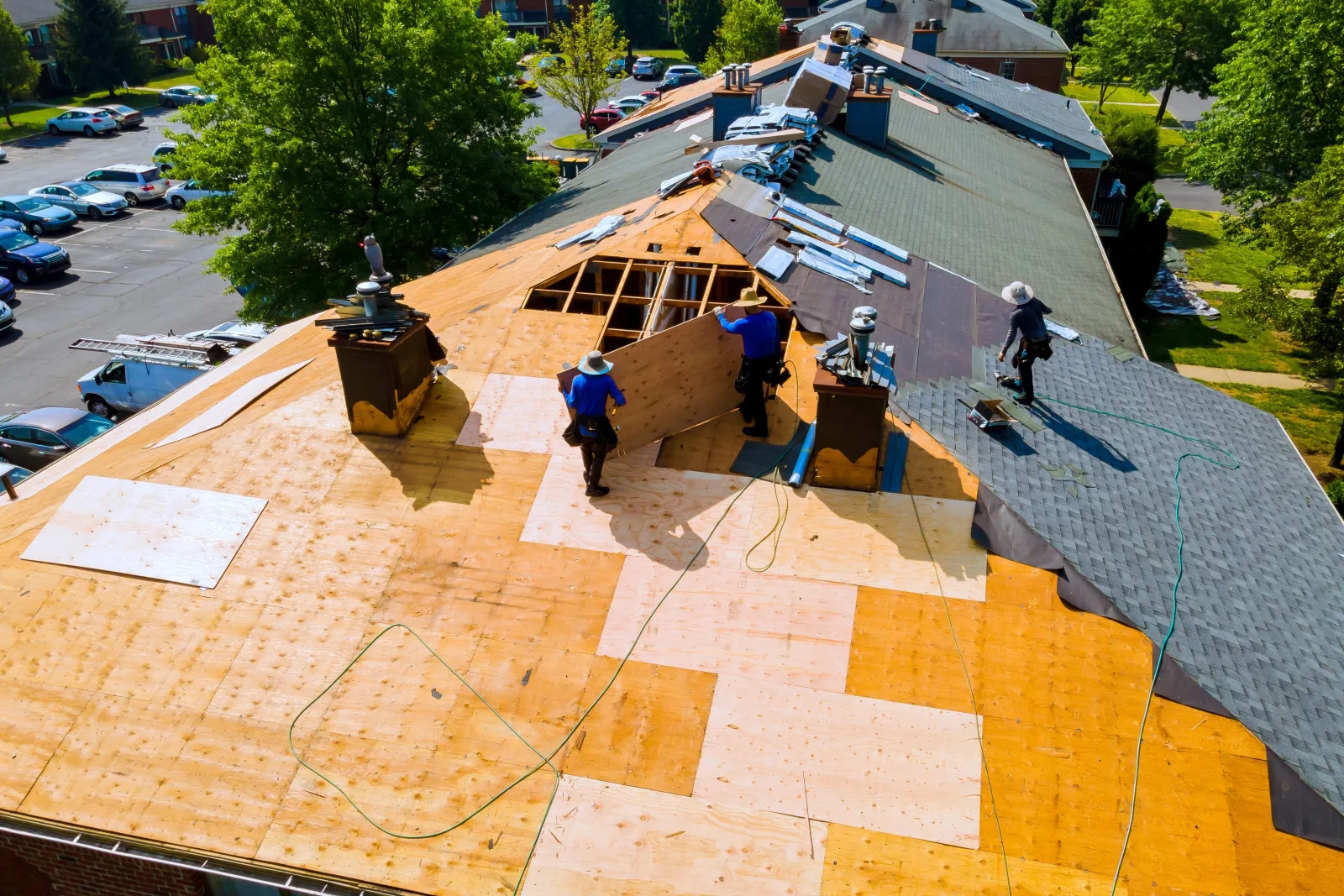
Real-World Scenario: Three relationships to one roof inside a single fortnight, and only one of them could ever have been written on a building contract. A vacant house goes under agreement. The party who signed passes that agreement along a few days later, having been inside once and never intending to close on it. Somebody else closes, takes the keys, and has a crew opening the rear wall by the following week. On the Saturday in between, wind lifts part of the roof covering. The seller still owned the house that morning. The party who passed the agreement on was never going to own it at any point. The party who eventually closed did not own it yet either, and their crew had not arrived. Everyone involved is affected and their exposures are three different things, which the paperwork could have distinguished long before an adjuster had to.
What gets asked at submission, and what answers it
None of this requires a new document. It requires the file to be able to answer three questions in the order an underwriter asks them.
Which party is being written for. A name, not a role. The answer is different before and after the sale goes through, and the file should say which side of that line the arrangement is meant to sit on.
What that party’s relationship to the structure is, and from when. An expected date of transfer while the sale is pending; the transfer instrument once it is done. This is the question the whole placement hangs from.
Who else has a stake worth recording. A lender is the common one. A general contractor and the owner of plant on site are the others, and each of them is holding something different.
Everything needed to answer all three is produced by the deal itself. The work is noticing that the answers change on a date, and that the date is not the day the agreement was signed. What the placement then costs to arrange is a separate conversation, built on the answers rather than ahead of them.
The assignment questions this page is deliberately leaving alone
A reader who came here expecting a comparison of the two routes should have the omissions named rather than discover them.
How to locate an agreement worth taking on is a sourcing question, and it belongs with the other ways a rehab gets found. What either route pays, what a fee looks like, and which one comes out ahead are not questions this page will touch, because the answer is always about one deal that nobody here has seen. How buyers get found and organized is a marketing subject. And whether an arrangement of that kind is permitted, and on what terms, varies by where the house sits and is not an insurance matter at all.
What is left after all of that is the part that genuinely is ours: one route produces an owner of a building, and the other produces a party with no building. That single difference decides whether there is anything to place, and it decides it before any of the rest of the comparison begins.
Where a project does end in ownership, the shape of the whole arrangement is set out in the fix and flip insurance overview, with the finish-work end of it under what house flipping insurance covers. If the names and the dates on a file are settled and the placement is not, send both through — the name and the date, since a placement cannot be built from only one of them.
The bottom line
A property contract answers to a party who would lose something if the building were damaged, which means the route that ends in ownership and the route that never takes title are not two versions of one insurance question — one of them has a subject for a policy to attach to and the other has a transaction.
Frequently asked questions
A purchase agreement is signed and the sale has not gone through. Can anything be bound on the building yet?
It is the wrong question in the wrong order, because the placement is arranged against a date rather than against a signature. What an underwriter needs is the day ownership is expected to move and the name it will move to, so the arrangement is usually built now and dated forward. Nothing about the structure has changed hands in the meantime.
If the agreement is passed to somebody else and title never reaches me, what is there for me to insure?
Nothing that a building policy is built to answer. That party walks away from a document rather than from a structure, so a fire on the site is somebody else’s rebuild. The exposures that do attach to that role are not exposures to a roof, and a page about placing renovation cover is not where the answer to them lives.
Does the seller’s arrangement protect the incoming buyer during the weeks before the sale goes through?
Treat that as no until somebody shows otherwise in writing. A contract written for one named party measures what that party would be out, and a second name does not appear on it because a purchase agreement exists somewhere. Whether anything is contemplated for an incoming owner is a question to put before the date arrives, not after.
Can two parties really be exposed to the same building at the same time?
Routinely, and the published residential special form assumes it. Its own condition begins by supposing that more than one person may hold an interest in the covered structure, then caps what each of them can be paid at the size of that interest. Naming several parties distributes the recovery rather than multiplying it.
What piece of paper actually establishes the interest once the sale is done?
The instrument recording the transfer. The Consumer Financial Protection Bureau describes the buyer receiving a document most often called a deed, which shows the seller passed legal ownership across. Before that exists the relationship is to an agreement; afterwards it is to a structure, and the second is the relationship a building form is written around.
The renovation crew is carrying its own cover. Does that reach the structure itself?
It reaches what that business would be out, which is its work, its plant and its own liability. The building is not among those things. Two parties standing on one job site can each hold something real and still be holding different things, which is why the certificates in the folder are not a substitute for a placement on the structure.
Is there an insurance argument for choosing one route over the other?
That is a decision about one deal and this page will not reach for it. What can be set out is the mechanic: one route produces an owner of a building and therefore a subject a property contract can be written against, and the other produces neither. Everything else about the comparison sits outside insurance entirely.
About the author

Nate Jones, CPCU, is the founder of Wexford Insurance and Fix and Flip Guard Insurance, a specialty agency placing fix-and-flip real estate investment coverage in 48 states across 10+ carrier markets. Nate opens a renovation file on the names rather than the address, because the first thing any property placement has to settle is which party it answers for and what that party would actually be out if the roof came off on a Tuesday. Reach him through the Fix and Flip Guard Insurance quote form or call 888-346-2414.