
States we serve · Texas
Fix and Flip Insurance in Texas
Texas is two insurance markets wearing one state’s name. Inland, a renovation is a single placement and a local permit. On the coast the same job carries an inspection, a certificate and a separate wind policy before anyone will write it.

What fix and flip insurance costs in Texas
We do not publish premium ranges for Texas, and the reason is not coyness. A renovation is priced off the specific job, and the same house on the same street prices differently depending on what you are doing to it. Anyone quoting you a Texas number before they have read your scope of work is quoting you somebody else’s project. What follows is what actually moves the number, in roughly the order an underwriter asks about it.
The scope of work, which decides the policy before it decides the price
The first question is not how much — it is which form. Paint, flooring, cabinets and fixtures on a house whose structure and systems stay put is a different risk from a job that opens walls, moves something load-bearing, replaces a roof deck or takes the electrical and plumbing back to the studs. The first usually stays on a dwelling policy carrying a cosmetic repair endorsement; the second is a construction risk and belongs on builders risk. Describing the work accurately at the submission is the cheapest thing you will do all project.
Completed value, not purchase price
A construction placement is built around what the property will be worth when the work is finished, not what you paid at closing and not what the house is worth halfway through. Those are three different numbers and only one of them is the one the policy is written to. The figures are yours — your acquisition, your budget, your after-repair value — and the underwriter is reading the relationship between them rather than any one of them alone.
How long the house stands, and the Texas calendar
Duration is priced because exposure accumulates. A project that runs long is a project that is empty longer, exposed to more weather, and more likely to outlive its own policy term. In Texas the calendar has a specific shape: a job open through spring is a job open through the hail season, and a job open through winter is a job whose plumbing has to be winterized properly or not at all. The listing period after the crew leaves counts too — the house is still empty while it sits on the market.
Where in Texas the house is
Location is not a rounding factor here. The peril profile below changes the placement structure, not just the rate: on the coast and in Harris County on Galveston Bay, wind and hail commonly come out of the property policy entirely and go to the Texas Windstorm Insurance Association, which means two placements and an inspection step. Flood is a separate policy everywhere in the state. A project in El Paso and a project in Houston are not the same risk with different postcodes.
Vacancy, who is swinging the hammer, and what happened last time
Three questions close out the file. Is anyone living in the house — and on a flip the answer is almost always no, which is precisely why the vacancy provisions in an ordinary dwelling form matter so much. Who is doing the work: a licensed general contractor carrying their own general liability, a set of trades you are coordinating yourself, or you and a crew. And whether there are prior losses on your record, which changes pricing materially and is the one input you cannot rewrite at submission.
Cost is the question this page gets asked most, and it has its own page: the Texas cost guide walks the drivers a carrier weighs on a renovation here, in the order this state makes them matter. Texas fix and flip insurance cost guide.
Texas regulations and licensing for a fix and flip
Texas regulates the insurance tightly and the construction barely, and a rehabber who assumes the opposite gets caught. The insurance side has a single named regulator, a statutory residual market and a certificate regime on the coast. The contractor side has no state license at all. Both of those facts are load-bearing for a project.
The agency that regulates the policy, not the building
The Texas Department of Insurance (TDI) regulates insurers and agents in Texas and is where a complaint about a policy or a producer goes. It is also the agency behind the coastal certificate described below. What it does not do is tell you whether your renovation is legal — that is the local building official, several paragraphs down.
Nobody in the state licenses your general contractor
This is the fact most often got wrong about Texas, and it is an affirmed absence rather than a gap in our research. No Texas state agency licenses general or residential contractors, and the state’s residential construction regulator was abolished without a successor. Cities and counties set contractor requirements, so the credential a rehabber needs depends on the jurisdiction the property sits in.
For an investor the consequence is procedural. There is no statewide license number to ask a general contractor for, so the verification that matters is local registration where the property sits, plus a current certificate of insurance you have actually read. A contractor’s policy answers for the contractor’s work; it is not a substitute for your own cover on the structure, and being named on somebody else’s certificate is paperwork rather than coverage.
The three trades Texas does license, by name
The absence above stops at the trades. Electrical work runs through the Texas Department of Licensing and Regulation: anyone performing non-exempt electrical work in Texas must be licensed and must perform it through a licensed electrical contractor. Plumbing is its own board entirely — the Texas State Board of Plumbing Examiners, which issues Responsible Master Plumber, Master, Journeyman, Tradesman Plumber-Limited and Plumbing Inspector licenses statewide. Heating and air conditioning returns to the Texas Department of Licensing and Regulation, which licenses air conditioning and refrigeration contractors. On a gut rehab those are exactly the three trades your job depends on, so the licensing that does exist in Texas lands squarely on your critical path.
Wind and hail on the coast: the windstorm association and the WPI-8
On the Texas coast, renovation work has to be inspected against the building standards TDI enforces and carry a WPI-8 certificate of compliance before Texas Windstorm Insurance Association wind-and-hail coverage will attach, so a coastal rehab carries an inspection-and-certificate step that the identical job inland does not.
Read that as a sequencing problem rather than a paperwork problem. The inspection has to happen while the work is open and inspectable, and a coastal project that closes its walls before the inspection has bought itself a demolition bill. The Texas Windstorm Insurance Association is a not-for-profit offering windstorm and hail coverage to coastal owners who cannot obtain it in the standard market — a residual market created for the purpose, not a carrier we place you with by preference. The identical rehab twenty miles inland has none of this.
When the standard market says no
Texas runs a second residual mechanism for property owners who are declined outright. The Texas FAIR Plan Association was established by the Legislature as an insurer of last resort and requires declinations before it will write. It is worth knowing it exists and worth not needing it: a renovation usually gets declined because of how the work was described, not because the house is uninsurable, and the specialty market that writes structural rehabs sees a well-documented scope of work very differently from a bare address.
What you owe the buyer when the flip sells
Texas has a statutory disclosure duty on resale. The Texas Real Estate Commission publishes the Seller’s Disclosure Notice, required of sellers of previously occupied single-family residences under Section 5.008 of the Texas Property Code. The practical point for a rehabber is that the condition being disclosed is the condition after your work. Permit records, inspection sign-offs and a written scope of work stop being project admin at that moment and start being the evidence behind a statement you are signing.
The permit is a local document, and Texas is a home-rule state
The State Energy Conservation Office at the Texas Comptroller sets the statewide residential standard by adopting the energy efficiency chapter of the International Residential Code for one- and two-family homes, but Texas is a home-rule state, local jurisdictions may adopt amendments, and local jurisdictions are responsible for code implementation and enforcement, so permits and inspections come from the city or county building official.
For insurance that matters in one specific way: the policy term is written around a schedule the local building official controls. A jurisdiction with a slow plan review can push a project past the term it was quoted on, and extending a construction term is routine if you ask before it lapses and a fresh placement on a half-finished house if you ask after.
Common fix and flip risks in Texas
The peril profile is the reason a Texas project is not an average project. Working from what the standard Texas residential property form actually responds to and what it leaves out:
The form responds to fire and lightning, explosion, theft, vandalism and malicious mischief, riot and civil commotion, aircraft and vehicle impact, and sudden and accidental discharge of water. Every one of those is more likely on an open site than on a finished house, and two of them — theft and vandalism — are the causes an ordinary dwelling policy narrows first once a building has been empty beyond the period the policy names.
Flood is excluded and has to be placed on its own, through the National Flood Insurance Program or a private flood policy. Earthquake and earth movement sit outside the form as well. And on the coast and in Harris County on Galveston Bay, wind and hail are frequently stripped out and placed separately with the windstorm association. Three of the perils that define a Texas property loss are therefore three things a single policy does not carry, which is the part investors moving into the state most often miss.
Layered on top of the natural perils is the ordinary risk of running an active site: an open structure, materials staged where they can be taken, trades coming and going, and a house that is empty every night. That combination is what general liability and a construction property form are between them written to answer.
Common Texas fix and flip claims we see
These are patterns rather than incidents, and there are no figures attached to them for the reason given at the top of the page. Each one maps onto the peril profile above.
Hail onto an open roof
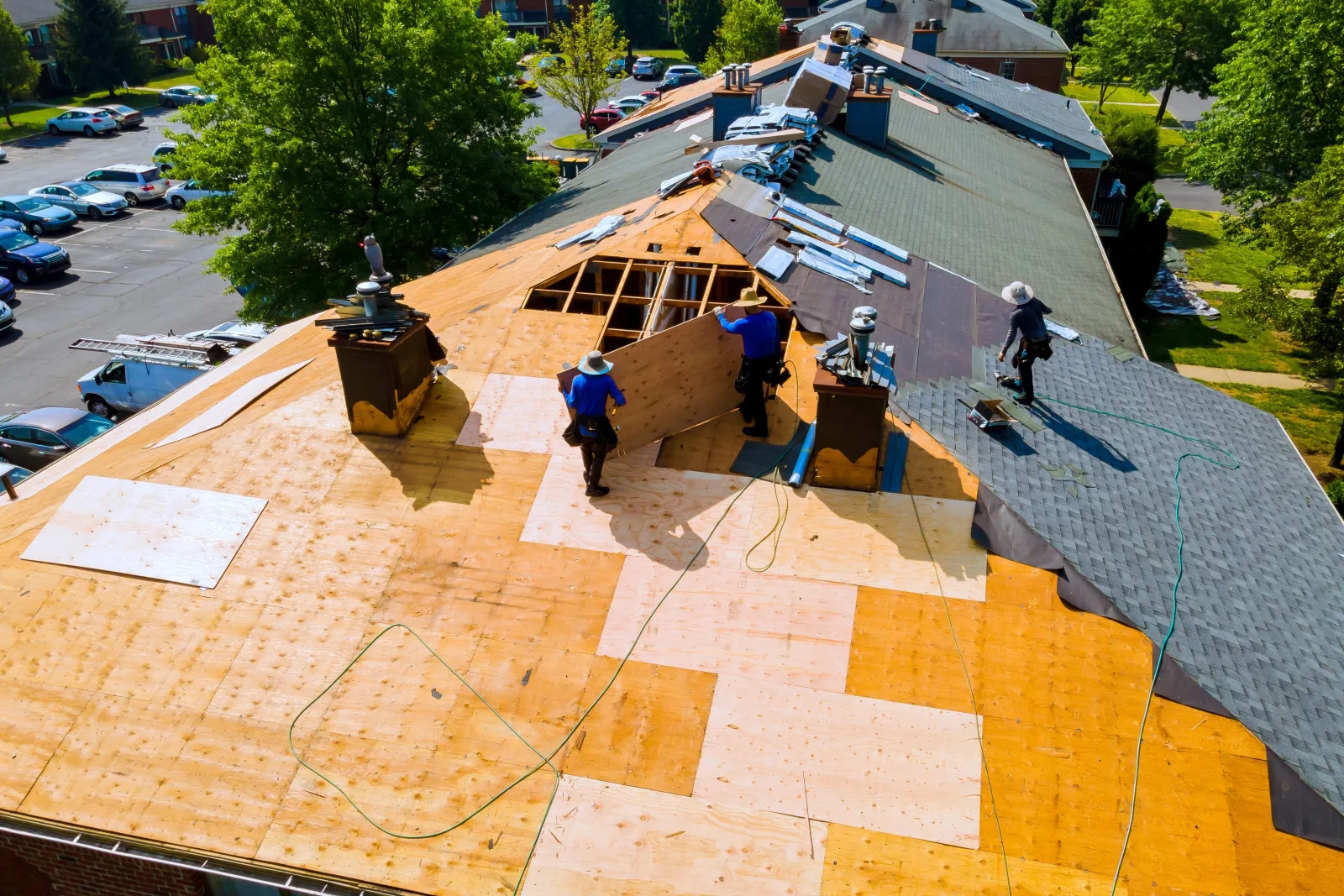
The signature Texas renovation loss. A roof deck is open between tear-off and dry-in, a storm arrives inside that window, and the damage is not the shingles — it is everything underneath that got wet. The claim turns on whether the opening was a covered cause of loss or a maintenance decision, which is a conversation about how the site was left rather than about the storm.
Freeze damage through plumbing that was winterized badly
A vacant house with the water on and the heat off is a burst-pipe claim waiting for a cold snap, and Texas gets cold snaps that its housing stock is not built around. Winterizing properly means drained and documented, not just shut off at the street. The loss is rarely the pipe; it is the finish work that was already installed underneath it.
Wind-driven rain into a partially finished structure
Distinct from flood and treated differently by the policy. Water entering through an opening the wind created is one question; water entering through an opening the crew created is another; and rising water is a third policy entirely. On the coast this is also where the wind placement and the property placement meet, and where a project running two policies finds out how well they were coordinated.
What goes missing between the last trade and the first showing
Copper, appliances, new HVAC condensers and staged materials, taken from a house nobody sleeps in. The exposure peaks twice — once when the materials arrive and once when the house is finished, staged and sitting on the market. That second peak is the one investors underinsure, because by then the job feels finished; it is the stretch a cosmetic rehab placement has to be written to survive. This is also the loss most likely to run into a vacancy provision on a policy that was written for a finished, occupied home.
Why Texas real estate investors choose Fix and Flip Guard Insurance
Independent agency, 10++ appointed markets, 48 states licensed. What that is worth on a Texas file specifically is the coastal structure — a property placement, a separate wind placement, and a certificate that has to exist before the second one attaches. That is a sequence we run, not a surprise we discover at binding.
Whether your job is a structural or gut rehab or a finishes-and-fixtures project decides the placement: the first is a fix and flip insurance placement led by builders risk, the second a house flipping insurance placement led by an endorsed dwelling form.
Everything turns on one distinction, and Texas tests it constantly. Getting that seam right is what decides whether the policy answers, and it is decided by your scope of work rather than by your budget.
And the Texas-specific piece is the one on the coast: renovation work there has to be inspected against the building standards TDI enforces and carry a WPI-8 certificate before windstorm association wind and hail coverage will attach. A rehab on the coast and an identical rehab inland are two different insurance problems, and quoting them the same way is how a coastal project ends up uninsured for the peril it was most exposed to.
Major Texas fix and flip markets
Where the work is, and what changes about the placement in each. Every market below is one this data layer carries for Texas.
- Houston. The flood market. Flood is excluded from the property form statewide, and Houston is where that exclusion is least theoretical — a rehab here is a National Flood Insurance Program conversation on day one rather than an afterthought, and the older housing stock that makes the best projects is the stock most likely to have taken water before you owned it.
- Dallas-Fort Worth. Hail country, and the reason roof sequencing is a coverage question in this metro rather than a scheduling one. A project that leaves a deck open across the spring storm season is carrying the peril this metro is defined by, and the tear-off-to-dry-in window is the single most exposed stretch of the whole job.
- San Antonio. A city whose oldest housing stock sits well inland of the windstorm association’s territory but close enough to the coast to catch the tail of a coastal storm as wind-driven rain. The placement is a single inland policy, so the exposure lands entirely on how well the structure was closed up rather than on a second wind form.
- Austin. The permitting market. Texas is home rule and the state sets only the residential energy standard, so the capital’s own building department controls the plan-review calendar the policy term has to survive — which makes term length and the option to extend it a live underwriting question here more than anywhere else in the state.
- El Paso. Far west, outside the hail corridor, outside the windstorm association’s territory, and the one major Texas market where the natural-peril conversation is quiet enough that the file turns almost entirely on vacancy, theft and who is doing the work. The simplest Texas placement to structure and the easiest to under-describe.
- The coast and Harris County on Galveston Bay. Not a metro but the state’s defining underwriting boundary. Inside it, wind and hail leave the property policy for the windstorm association and the work needs an inspection and a WPI-8 certificate of compliance before that coverage attaches. Crossing this line changes the number of policies on the project, not the price of one.
Related reading
Texas fix and flip insurance FAQs
Do I need a state contractor license to flip a house in Texas?
Not from the state. No Texas state agency licenses general or residential contractors, and the state’s residential construction regulator was abolished without a successor. That does not mean there is no rule — it means the rule is local. Cities and counties set their own contractor registration and permitting requirements, so the credential the job needs depends on the jurisdiction the house sits in.
Does my electrician need a license if I am managing the rehab myself?
Yes, and this is where Texas is strict. Anyone performing non-exempt electrical work in the state must be licensed and must perform that work through a licensed electrical contractor, under the Texas Department of Licensing and Regulation. Managing the project yourself does not change the trade requirement. Plumbing runs through a separate board with its own license classes.
The flip is on the coast and wind and hail is being quoted separately. Why?
Because on the Texas coast and in Harris County on Galveston Bay, wind and hail are frequently stripped out of the property policy and placed on their own through the Texas Windstorm Insurance Association. It is not a carrier being difficult. It is how the coastal market is structured, and it means a coastal project runs two placements where an inland one runs a single policy.
What is a WPI-8 and does my renovation need one?
It is the certificate of compliance TDI issues when construction or repair work has been inspected and complies with the building code. Texas Windstorm Insurance Association wind and hail coverage will not attach to the work without it. If the property is on the coast, the certificate is a step in the schedule — the inspection has to happen while the work is still open, not after the drywall is up.
Who issues the permit for a Texas rehab — the state or the city?
The city or the county. The State Energy Conservation Office sets the statewide residential energy standard by adopting a chapter of the International Residential Code, but Texas is a home-rule state: local jurisdictions may adopt amendments and are responsible for implementing and enforcing the code. Permits and inspections come from the local building official, and their timeline is the one your policy term has to survive.
Do I have to give the buyer a disclosure notice when the flip sells?
On a previously occupied single-family home, yes. The Texas Real Estate Commission publishes the Seller’s Disclosure Notice, required of sellers of previously occupied single-family residences under Section 5.008 of the Texas Property Code. What that means for a rehab is practical: the condition you are disclosing is the condition after your work, so your permit records and your scope of work are the documents you will be reaching for.
Is flood covered on a Houston project?
No, not on the property policy. Flood is excluded from the standard Texas residential property form and has to be placed on its own, either through the National Flood Insurance Program or a private flood policy. Earthquake and earth movement sit outside the form as well. On a Houston rehab this is the single most common gap we see on a policy someone inherited at closing.
Nobody in the standard market will write the house. What are my options in Texas?
Texas operates a residual market for exactly this. The Texas FAIR Plan Association was established by the Legislature as an insurer of last resort for property owners who have been declined in the standard market, and it requires declinations before it will write. It is a fallback rather than a plan A. On a renovation, exhaust the specialty market first — a project usually gets declined over how the scope of work was described.
Get a Texas fix and flip insurance quote
Send us the address and the scope of work.