
Flood, the NFIP, and a House That Is Not Finished Yet
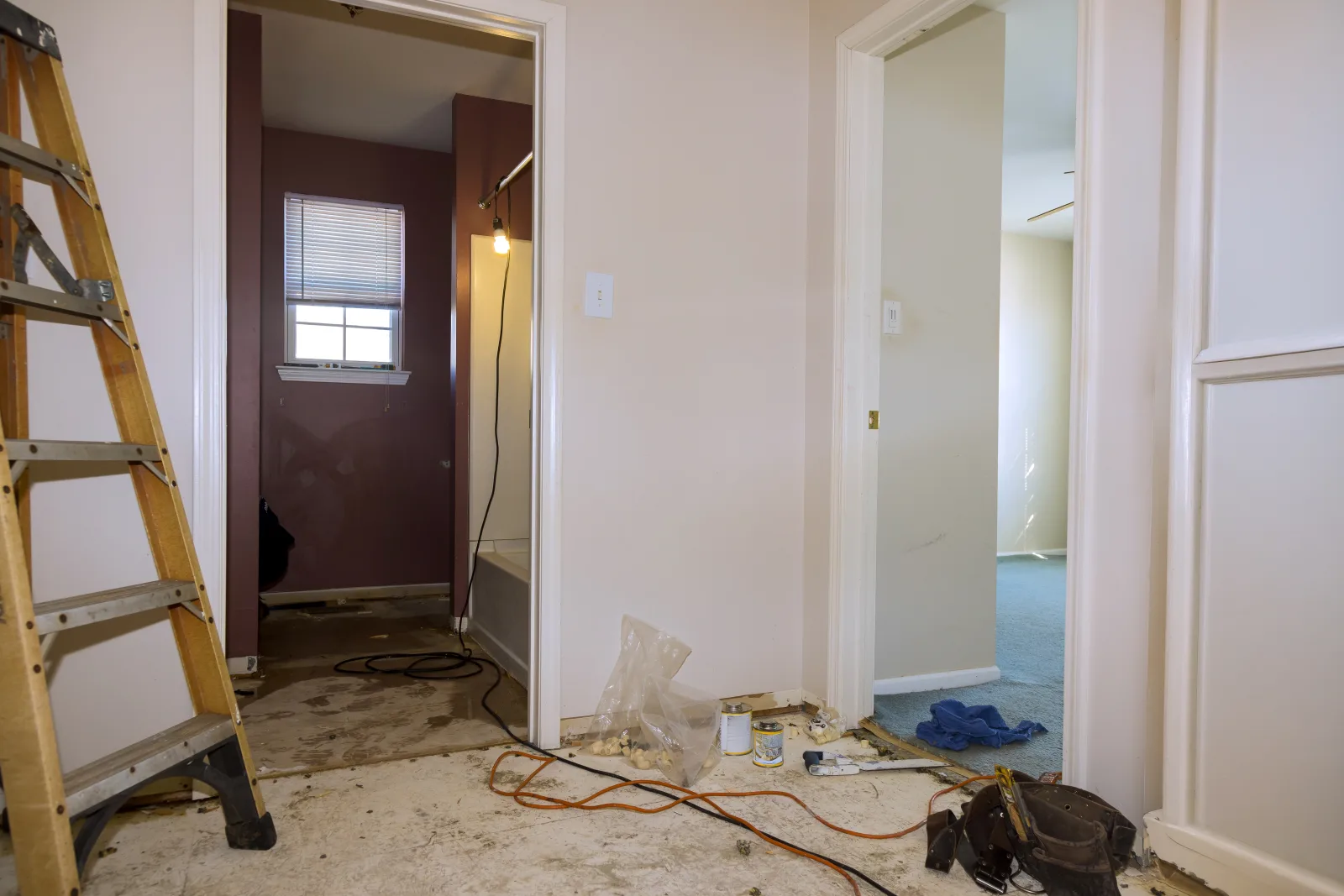
Flood is not an endorsement you add to the cover already on the rehab. It is a second contract with a different issuer, a different eligibility test, and a start date that is usually not today. On a house being taken apart, all three of those land differently than they do on a finished one.
The address has to qualify before the building does
Most placements begin with the building. This one begins with the jurisdiction, because the federal program is built on community membership rather than on individual underwriting. Wyoming states the condition more plainly than most: the state’s floodplain management program explains that participating communities agree to reduce their risk of future flooding by adopting and enforcing floodplain ordinances that meet or exceed the minimum NFIP requirements, and that in exchange the cover is available to everyone in the community. Not every Wyoming county and municipality participates, which is why on a Wyoming rehab the first flood question is about the town rather than about the lot.
The corollary is the half people get wrong in the other direction. Membership is not a flood-zone test. New Jersey’s Department of Banking and Insurance says it in one sentence in its own consumer guide: you do not have to live in a flood zone to obtain flood insurance, but you do have to live in a community that participates in the program. A parcel far from any mapped hazard is eligible in a member town; a parcel with water at the fence line is not eligible in a town that never joined. That is the framing the New Jersey entry carries, and it reverses the instinct almost every investor brings to the question.
What makes membership worth checking rather than assuming is the consequence the federal form attaches to getting it wrong. Its nullification condition does not decline the risk; it voids the policy from its inception where the listed property sits in a community that was not participating on the inception date and did not join or re-enter before the loss. A premium was paid, a declarations page exists, and nothing is in force.
What the federal form calls this house while the crew is inside it
The wording is public, and reading it is more useful than any summary of it. The Standard Flood Insurance Policy — Dwelling Form is published by the federal government at 44 CFR Part 61, Appendix A(1), and it opens by naming the property types it insures at all: a one to four family residential building not under a condominium form of ownership, a single-family dwelling unit inside a condominium building, and personal property in a building. It then defines a building as a structure with two or more outside rigid walls and a fully secured roof affixed to a permanent site.
Hold those two paragraphs beside a gut rehab and the tension is obvious. So the form addresses it directly, in a numbered item covering a building under construction, alteration or repair at the described location. Where the structure is not yet walled and roofed as the definition requires, cover applies only while such work is in progress, or — if the work halts — for a period of up to 90 continuous days after that. And a second condition sits underneath: cover does not apply until the building is walled and roofed at all where the lowest floor sits below the base flood elevation in the zones the form lists.
Read that as a description of a schedule rather than of a building. A stalled job is the exposure the drafters wrote about, which is worth knowing on a project whose bracing is out and whose next inspection is three weeks behind. The same item also reaches materials and supplies for the construction, alteration or repair, while they are stored in a fully enclosed building at the location or on an adjacent one — an allowance narrower than the one on a builders risk placement, and a different question from what the dwelling form on the house does or does not assume about occupancy.
The start date comes from a federal rule, not from the binder
This is the part that costs money, and it is not a company practice that a relationship can shorten. The effective-date regulation says that except in the situations it names, a new policy, added cover, or an increase in the amount of cover begins at 12:01 a.m. local time on the 30th calendar day after the application date and the presentment of payment of premium. The rule gives its own worked example, and it is measured from the application rather than from the closing, the funding or the day the crew mobilizes.
State regulators repeat it because consumers keep discovering it too late. North Carolina’s department tells owners the cover involves a 30-day waiting period before the policy becomes effective; however, there are exceptions. Both halves of that sentence matter, and the exceptions are worth learning by name rather than hoping for.
The exception a financed purchase reaches, and a cash one does not
There are three routes around the wait in the regulation, and only one of them is ordinary. Where the initial purchase is made in connection with the making, increasing, extension or renewal of a loan, cover on the property securing that loan is effective as of the time of the loan closing — provided the written request is received and the premium is presented at or before that closing. The other two are narrow: a window that follows a revised flood map for a community, and a route for property affected by flooding on federal land after wildfire.
The consequence for this trade is specific. An investor closing with borrowed money can have flood cover in force the hour the deed records, if the order is placed before the table rather than after it. An investor closing at a cash auction cannot reach that route at all, and is holding an uninsured exposure for the length of the ordinary waiting period no matter how quickly the application goes in. That is a scheduling input, not a pricing one, and it belongs beside the other things that actually move the number when the acquisition is being planned.
Raising the amount after the scope grows starts its own clock
The same regulation permits adding new cover or increasing the amount in force during the term of a policy, and then attaches a condition in the next clause: subject to any applicable waiting periods. The published form says the same thing from the other direction, allowing an increase by endorsement subject to the appropriate waiting period.
So the mid-project correction that works everywhere else does not work the same way here. On the renovation side, moving the figure when the walls come open is the normal step and the comparison between the two instruments is where that argument is settled. On the federal side, the increase is a fresh purchase with a fresh start date, which is an argument for settling the finished figure once, early, rather than chasing it upward through the schedule.
The deductible doubles while the shell is open, and nothing announces it
The deductible section carries a sentence written for exactly this building. When a building under construction, alteration or repair does not have at least two rigid exterior walls and a fully secured roof at the time of loss, the deductible is two times what would otherwise apply to a completed building.
It is automatic. It is not an election, it does not appear as a second figure on a declarations page, and it turns on the condition of the structure on the day of the loss rather than on anything anybody wrote down at binding. Which means the retention on a structural job is not the retention printed on the paperwork for as long as the envelope is open — and it is the printed one again the day the sheathing and roof are closed in.
The one policy that does not travel to the buyer with the house
The amendments, waivers and assignment condition permits a written assignment of the policy when title transfers to someone else, and then removes two situations from that permission. One is a policy insuring personal property only. The other is a policy insuring a building under construction.
On a flip, that second exception is not an edge case; it is the file. The instrument that covered the exposure through the work cannot be handed over as part of the deal, so the resale has to be planned as the buyer arranging their own placement, on their own application date, with their own waiting period running. On a light finish-work project that is an inconvenience. On a job where the buyer’s lender requires flood cover at closing, it is a date on the critical path.
Real-World Scenario: The flood decision gets deferred because nothing in the file is forcing it. A rehabber buys a single-story house at a cash auction in a town that has been in the federal program for years, places the renovation cover the day the deed records, and leaves flood for later — the parcel sits outside every mapped hazard area and no lender is asking. In month three the back wall comes down for an addition. A storm pushes water off a saturated field and through the opening, and the claim lands on a contract that was never written to answer for rising water. The application that would have answered was never made. Because the purchase was cash rather than financed, the closing-table route around the wait was never available either, so even an application made that same week would have left the loss uncovered. Nothing about the house was ineligible. The calendar was the entire loss.
Reading the federal side of the file before the renovation side
Three checks, in this order, and none of them needs an underwriter.
First, the jurisdiction: confirm that the city or county holding the address participates in the program, before the offer rather than after it, because that is the question that decides whether a placement exists. Second, the date: fix the application date against the acquisition date, and establish whether the purchase is financed — that single fact decides which effective-date route applies. Third, the condition: if the structure will be open, read the construction item in the Dwelling Form and the deductible sentence beside it, because both are written about the building your crew is standing in rather than about a finished one.
On the paperwork itself, the terms to look for are the form’s own: the Standard Flood Insurance Policy — Dwelling Form as the contract, its Policy Nullification condition, its amendments and assignment condition, and the effective-date rule at 44 CFR 61.11 that the start date comes from. Everything on that list is published, and none of it is a carrier interpretation. What none of it settles is the water that arrives from a drain rather than from a field — Indiana’s department draws that line, recording that sewer and drain backup is picked up by some policies while most of those same provisions carve out a backup that a flood caused, which is why an Indiana basement rehab has to settle the two questions separately.
Where the jurisdiction answer actually lives
The federal rules above are the same in every state. What is not the same is the town, and that is the variable this whole placement turns on — the state pages carry each department’s own words on where flood sits relative to the property form, which is the fastest way to see how differently regulators describe the same federal program. Where the work is light enough to sit on an endorsed dwelling form, the flood question is unchanged; the form under it just happens to be a different one. When the address is settled and the calendar is not, send us the house and the closing date and we will work backward from it.
The bottom line
Flood on a rehab is a second contract rather than an endorsement, and three of its rules land differently on a building nobody has finished: eligibility runs through whether the town ever joined the federal program, the start date is fixed by a federal effective-date rule instead of by the day a binder is signed, and the published federal form reads a structure that is not yet walled and roofed as something it answers for only while the work is actually moving.
Frequently asked questions
The house sits outside every mapped flood zone. Is there anything left to decide?
Two things, and neither is the map. The first is whether the jurisdiction joined the federal program, because that is what opens the purchase at all. The second is when a policy would begin, which a federal effective-date rule governs rather than the day an agent takes the order. New Jersey’s regulator puts the first point in writing: an owner need not live in a flood zone to buy the cover, only in a participating community.
We are paying cash at the auction. Does that change when a federal flood policy starts?
It changes which rule the start date comes from. The federal effective-date regulation carries a separate route for a purchase made in connection with a loan, under which cover begins at the loan closing itself provided the request and the premium are in before that closing. A cash buyer never reaches that route, so the ordinary waiting period applies and the calendar has to be planned around instead of negotiated.
The roof deck is off and two exterior walls are open. Is the structure still insurable while it looks like that?
The published federal form addresses a building under construction, alteration or repair directly, rather than going quiet about it. Where the structure is not yet walled and roofed as the form defines those words, cover runs while the work is in progress and for a limited stretch after work halts. There is also a condition tied to elevation that suspends cover until the building is walled and roofed. Read both before assuming either.
We raised the insured amount after the scope grew. Is the extra amount answering yet?
Probably not on the day it was requested. The federal rule permits increases during the term of a policy, and then says in the same breath that they are subject to any applicable waiting periods. So an increase is not a correction backdated to the original bind. It is its own purchase with its own start date, which is a reason to argue the finished figure early rather than to adjust toward it as the schedule moves.
Can the flood policy go to the buyer along with the house at closing?
Usually yes, and on this particular building usually no. The form’s amendment and assignment condition permits a written assignment when title transfers, then removes two situations from that permission, and one of them is a policy insuring a building under construction. On a flip that is the whole point, so the resale has to be planned as the buyer arranging their own placement rather than as a handoff of the one already in force.
The town has never joined the program. Is there a version where a federal policy still answers?
Not through this route, and the form is blunt about the consequence rather than simply declining the risk. Its nullification condition voids the policy from inception where the listed property sits in a community that was not participating at inception and did not join or re-enter before the loss. That is a refund, not a claim. It also means a policy can exist on paper while answering for nothing at all.
About the author

Nate Jones, CPCU, is the founder of Wexford Insurance and Fix and Flip Guard Insurance, a specialty agency placing fix-and-flip real estate investment coverage in 48 states across 10+ carrier markets. Nate has seen more flood files fail on a calendar than on a map: the parcel was eligible, the price was reasonable, and the only thing wrong with the placement was the date somebody got around to applying. Reach him through the Fix and Flip Guard Insurance quote form or call 888-346-2414.